Thursday, December 4, 2014

English nerd to journalism geek

The transition

SID Students film GameDay: Northwest
Eighteen months ago, I embarked on a new journey in my teaching career: transitioning from English teacher to a Convergence Journalism instructor at Olathe Northwest High School.

For 10 years, I taught English at Olathe South and ONW. I feel like I came a long way teaching English from my early years when I didn't know how to teach Julius Caesar or Close Reading strategies.

I majored in English and Journalism at K-State, and it was always my dream to teach Video Journalism. It was just a natural move for me to go from English teacher to Journalism teacher, while incorporating my love of video, technology and social media.

However, last year I felt like I was behind the learning curve of my students. The software, technique, studio and cameras were all foreign to me. I felt like a brand new teacher all over again.


Washington, DC bound

Last February, I traveled to Washington, DC to learn the concept of Backpack Journalism from Bill Gentile. Backpack Journalism is the idea that anyone can film, edit and tell a story with equipment that will essentially fit in your backpack. 

Working with Jerry Gardiner on his backpack journalism video
I elected to do my story on one of the workshop participants, Jerry Gardiner, who came from Liberia, Africa to learn video storytelling. I followed Jerry on his journey for two days, documenting his mission to film and edit his story. Here is my finished documentary:


This experience taught me so much about video storytelling. I learned the six-shot system and the concept of video sequencing.

It was such a great experience that we brought Gentile to Olathe Northwest High School last summer to work with 15 of our students. The students learned a great deal, and I took away even more ideas for my students.
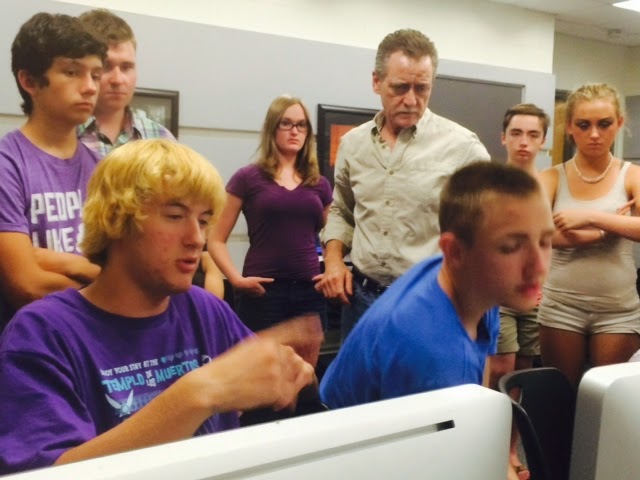
Bill Gentile working with our students in the summer

Tri-ing new things

Last year, our studio and equipment was falling apart. It had not been replaced since the building opened 11 years ago. 

This year, we tore out the old set and changed our studio into a green screen, infinity wall. We also ordered a new tri-caster system that allows us to produce our ONW...NOW! shows in a much more efficient and up-to-date way. We use a virtual set for our anchors, and we can produce the show with fewer people than we did before. Overall, it runs much smoother than our old set-up.

Students producing ONW...NOW!
Here is an edition of a show from this year:


Sophomore redesign

One other change we made this year was to redesign our sophomore video curriculum. I was excited to share what I learned from Bill Gentile, and I saw many of the ideas were applicable to our sophomore class. 

We started the year with "Cutting Carrots" which is a filming and editing exercise that implements the six-shot system and sequencing. Here is an example:


We took this simple concept and applied it to the rest of our projects: AB Sequencing, Chase Scene and music videos. The last two projects directly applied the ideas of backpack journalism, where students filmed each other putting together legos and told the story of the blood drive.

Sophomores filming the Lego Project
I feel great about the direction our sophomore video class is going, and I believe our students will be much more prepared for my Convergence Journalism in the future.

Looking to the future...

I have a vision for where I would like to take this program. A few goals I have for the future are:

1. Learn more about the tricaster. I am hoping to attend a workshop in New York City this spring where I will learn how to use the tricaster to its full potential. I know it can do much more than we already do with it.

2. Implement more writing in the class through news articles and student blogs. I spent most of first semester working on the video portion of the class, and I feel great about the progress we have made. I want to improve our writing and begin creating stories for our Raven Daily website.

3. Win awards. e-Magine is our spring film festival that we host every year. Last year, we didn't win any awards in the news story category. After the competition last year, I told the class I was making it a goal to win awards at e-Magine. I feel great about the work we have done, and feel we can be competitive this year.

Final thoughts

I feel like I have come a long way in the last 18 months as a convergence journalism teacher, but I know I still have a great deal of work to do. I am constantly reading other blogs, websites and communicating with other journalism teachers. It has helped me grow a great deal. I am excited about where I will be a year from now when I look back again.


Wednesday, November 19, 2014

Article review: Digital Innovation and the Future of Storytelling


1. Read the article: "Digital Innovation and the Future of Storytelling"

2. On your blog, reflect on the article using the following directions:

Title Your Blog Post
A title that reflects the thrust of your review. For example, the article title is "The Political Ecology of Deforestation in Chile." Your title might be "They're Only Trees:  Cutting Down Old Growth Forests in Southern Chile."


In a written reflection answer the following questions:


  1. Write a summary of the article, identifying the three key points.
    1. 1-2 sentence summary.
  2. Discuss the author’s argument.
    1. What is the author's argument and what information/evidence and sources does he/she use to support that argument?
    2. What are the article’s/author’s strengths and weaknesses?
      1. The strength of the article may be that it presents a clear summation of a particular issue. Its weakness may be that it does not offer any new information or solutions.
    3. What are the author's general conclusions?
  3. Your critique (A critique is not whether you liked the article or not. Rather, you should assess whether the the main point(s) is really significant)
    1. Does the author's argument support the main point(s)?
    2. Is the evidence convincing? Are there wider ramifications to the conclusions?
    3. What are the applications/implications to you as a graphic designer/web designer/animator/videographer?
    4. What don't you understand, and is this because you lack certain assumed knowledge or vocabulary or because the writer is unclear?
  4. General thoughts & conclusions.
  5. Include a citation/reference to the work.


Each question should be written in complete sentences and provide examples of support.

Your post should not read like a classroom assignment. Speak to your audience as if you did this as a budding “Creative” and you are sharing your experience. Your writing should be conversational and yet still professional.

You will be graded on the following criteria: Content and Voice.

Friday, November 14, 2014

6-shot system

Last winter I learned the 6-shot system from Bill Gentile for video storytelling. This system gives videographers a game plan for shooting video.

There is a list of six shots to get, and you can keep cycling through those shots to get everything you need to tell a story.

The shots are:

1. Close-up of the hands
2. Close-up of the face
3. Over the shoulder
4. Medium shot (Waist up)
5. Wide shot (Feet up)
6. Extra-wide shot (Establishing)


The first exercise I have my students complete is called "Cutting Carrots." This exercise asks students to film someone doing something routine, using the 6-shot system. They then will edit it together in a SEQUENCE to tell a short story.

Here are some examples:


This is what it looks like when applied to a complete news package:


This method for shooting video has given my students a game plan for shooting video. No longer do they go shoot and "Spray and pray." Shooting everything around and hoping to have something great. 

Friday, November 7, 2014

Awesome interview responses

I asked my students to come up with five tips for awesome interviews. I received some great responses. Here are some of their tips with a link to their blog post:


Isabel Lauby: It is important to determine the location of the interview that is pertinent to the story line.  For example, when I did my package over boys on the drill team, I interviewed their coach while the band and drill team was practicing, providing a relevant background.  If you capture your interview 
in an interesting setting it will make your package better.


Pedro Von Simson: 
Use your first questions to make the subject feel comfortable. Incorporate easier questions about subjects such as their background that do not make the interviewee defensive. If you immediately start off with your tougher questions, your interviewee with be less likely to feel comfortable and therefore provide worse answers.

Tougher questions should close out the interview. These are the "meat" of the package where you get the important and controversial answers that lead to the soundbites that you will most likely incorporate into your package. The first questions are more important to develop background information about your subject for your voice over instead of being used as sound bites.

http://kansaskonvergence.blogspot.com/2014/11/five-tips-to-successful-journalism.html


Quen Barkyoumb:  Prepare everything that you'll need to conduct an interview. Make sure your camera angle is on point, audio is at the right level, your computer is charged, the lights are in the right spots, and every setting is at its correct degree. This will give your interviewee a sense of importance because you're all ready to proceed without any distractions. If you're messing around with your technology during the interview, then your respondent is likely to be annoyed.

Monday, October 27, 2014

Challenge: Interviewing Tips & Tricks

1. Watch this video from Digital Juice about Interviewing Tips.

2. Your challenge: Create a video tutorial about five interview tips similar to the one in the link above.


3. Write a script and storyboard before you begin shooting.

4. Use examples and non-examples. This should be a video that teaches future students how to set-up, film and conduct an interview.

5. Think about the different phases of an interview: pre-interview, interview, post-interview (editing phase).

6. Post your video to your YouTube channel and blog. Include the tips with a short explanation on your blog under your video.

Friday, October 10, 2014

Cool video: Electrathon car

I wanted to share this cool video that a couple of my students produced:


Two things really stood out to me in this video:
  1. Storytelling. This video has a clear beginning, middle and end. The video starts with an unassembled car. Throughout the video we see students working on and building the car. The final shot is the finished car driving away out of frame. Story. It is so simple, but something that is so hard to do.
  2. Shot composition. We have worked hard on the six-shot system and sequencing. This video is textbook in my opinion. We see a student turn the steering wheel, and the next shot is the actual wheel turning. Another sequence has the student being interviewed while we see a shot sequence of him: close-up of his hands and face, a medium shot and wide shot. There are more sequences throughout, but this does an excellent job.

Friday, October 3, 2014

Analyze: Web vs. TV stories

Check out these three videos about the same subject: a soccer freestylist. Two were produced for the web (ESPN), and one was produced for a local TV station.

Web

Web #2

TV (This may take some time to load, even though it says it isn't working)

On your blog (in complete paragraphs):
  • Which was your favorite version of the story? Explain why
  • Discuss three elements that the videos have in common.
  • Discuss three elements that are different.
  • If you were to summarize it, what is the difference between web videos and TV?
  • What elements can you emulate in your own work?